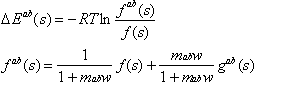
where mab is
the number of pairs, a and b observed, w is the
weight given to each observation, f(s)
is the relative frequency of occurrence of any amino acids at grid point s,
and gab(s) is the equivalent relative frequency of
occurrence of amino acid a against base b. R and T
are gas constant and absolute temperature, respectively. Here, we used a
box of |x| = |y| =13.5Å and |z| = 6 Å and a grid interval
of 3Å, which was determined by examining various intervals. In
order to quantify the specificity, we evaluated Z-score by calculating
energy against 50,000 random DNA sequences. Z-score is defined by (X - m)/s in the histogram, where X
is sum of contact potential in a complex form, m is mean energy
over 50,000 combinations and s is standard deviation of the
energy. For example, Z-score of -3.0 means that
there are potentially two DNA sequences that are better fit to the
framework among 1,000 random sequences.